Recommendations from Polish Circular Forum
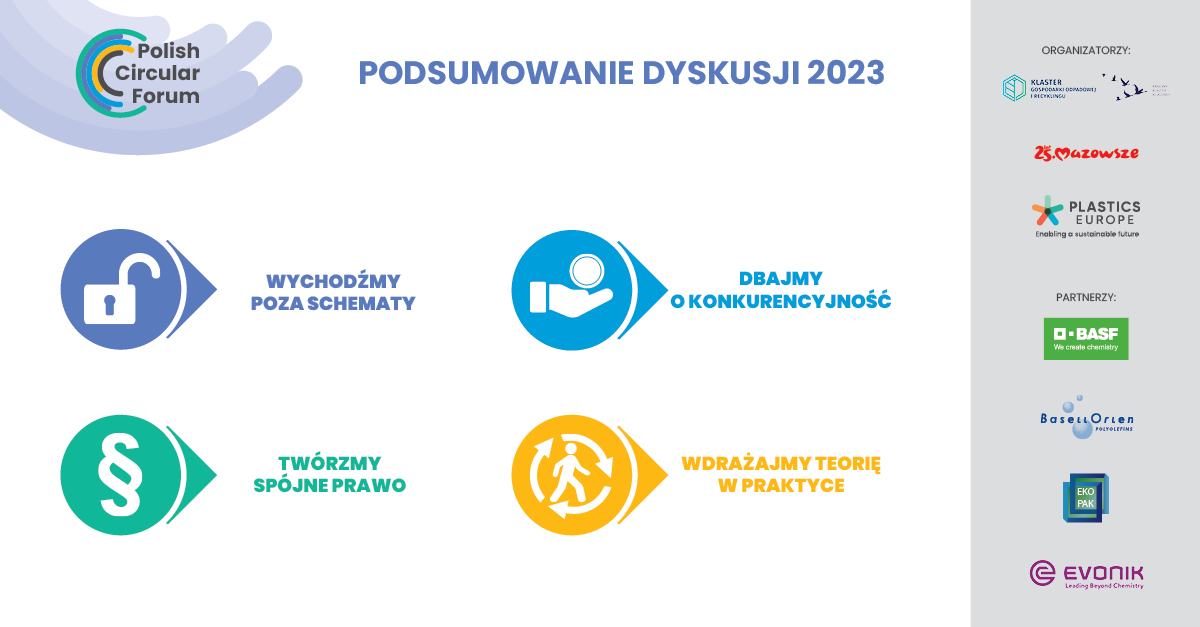
Roundtable discussions at Polish Circular Forum 2023 covered as many as 20 different topics. The discussions produced a rich collection of conclusions and recommendations for developing circularity in Poland. Key observations on each topic were selected from the table summaries. They were organised under four main themes reflecting the most important conclusions of the second Polish Circular Forum.
Polish Circular Forum is a unique event devoted to the circular economy in Poland and Europe from an industrial perspective. It is aimed at business representatives throughout the value chain, from raw material producers to recyclers, as well as public administration, trade and non-governmental organisations and the media. The event brings together industries striving to meet ambitious zero-emission and circularity targets.
Polish Circular Forum 2023 is organised by the Waste Management and Recycling Cluster – National Key Cluster, the PlasticsEurope Polska Foundation representing plastics manufacturers, and Mazowieckie Voivodeship. Together with Forum participants, we create a valuable platform for exchanging knowledge and experience. The engaging debate format enables everyone to contribute actively to conclusions on a sustainable economy. Last year's participant contributions enabled us to develop recommendations that helped form the basis for the second edition's topics.
This year saw the second Polish Circular Forum 2023, with discussions at 20 different thematic tables. We present recommendations resulting from discussions on developing circularity in Poland. All observations were organised under four main themes reflecting the second Forum's most important conclusions.
DOWNLOAD the Conclusions #PCF
A reminder of the 20 circular roundtable topics
ROUNDTABLES: Circular business: raw materials, processes and products
Circular raw materials as the industry's response to contemporary challenges. Tomasz Listoś, Basell Orlen Polyolefins
Energy carriers: life cycle. Robert Makieła, Wastes Service Group
Cooperation in the plastics value chain as the key to the circular economy. Anna Kozera-Szałkowska, PlasticsEurope Polska Foundation
A new business perspective on sustainability. Kazimierz Borkowski, Ambiente
Re-Raw Materials as a pillar of the circular economy. Katarzyna Błachowicz, Waste Management and Recycling Cluster
Composites in a closed loop. Dr Tomasz Żuk, Łukasiewicz Research Network – Institute for Engineering of Polymer Materials and Dyes
Challenges of circular technologies. Łukasz Kordon, Evonik
Calculating the carbon footprint throughout the product life cycle. Agnieszka Łyczak-Szymczyk, BASF, and Tomasz Radomski, ATOS Polska
The role of chemical recycling in the circular economy. Aurelia Zych, BASF
Closing the loop from a consumer perspective. Agnieszka Plencler, Consumer Forum
Circular sustainability strategies. Piotr Nejman, Waste Management and Recycling Cluster
Circular investments: green procurement. Katarzyna Wolny-Tomczyk, Eco Legal law firm
Circular investments: decisions, permits and reporting. Małgorzata Kozicka-Ochal, Marshal's Office of Mazowieckie Voivodeship
Sustainable products: recycled content. Radosław Domagała, PlasticsEurope Polska Foundation
Ecodesign and sustainable design. Prof. Maciej Konopka, Academy of Fine Arts
Circularity and low emissions: the consumer perspective. Izabela Jaskólska, Basell Orlen Polyolefins
Repair and extending product life. Dorota Napierska, Zero Waste Europe
Circular textiles. Paweł Boczek, VIVE Textile Recycling
Water: a sustainable resource. Tadeusz Arkit, Councillor of the Małopolskie Regional Assembly
Barriers to the flexible packaging value chain's transition towards a circular economy. Magdalena Dziczek, EKO-PAK Employers' Association for the Packaging and Packaged Products Industry